Alfa Romeo history
Autodelta: the small team that became Alfa Romeo's competition department
Autodelta began away from Alfa Romeo's factories, with a tubular-chassis Zagato coupé and a compact group able to make decisions quickly. Within two years it was Alfa's works racing operation; over the next two decades its name became inseparable from the GTA and Tipo 33.
Alfa Romeo did not need racing explained to it in the early 1960s. The company had won the first two Formula One World Championships in 1950 and 1951, then withdrawn from Grand Prix racing while it concentrated on becoming a larger producer of road cars. The Giulietta and Giulia brought Alfa engineering to a broader public, but the marque's identity still depended on proving its cars in competition. What it lacked was a works organisation with the freedom and focus to turn production-based ideas into winning racing cars.
Autodelta supplied that organisation. Its importance is sometimes reduced to a catalogue of victories, yet its structure mattered just as much: a specialist concern, initially independent and physically separate from the main plant, could develop, prepare and run cars without every decision travelling through a mass-production company. It connected Alfa's road-car engineering to international competition and gave one technical team continuity across touring cars, sports prototypes and experimental projects.
From Auto-Delta to Alfa's works team
On 5 March 1963, engineer Carlo Chiti and the Chizzola brothers founded the company at Feletto Umberto, near Udine. Alfa Romeo's own anniversary history describes its immediate purpose as collaboration on the Giulia TZ. Chiti brought experience from Alfa Romeo and Ferrari; the Chizzola family supplied the practical base around which the new operation could work. Contemporary references often render the original name as Auto-Delta, while the combined Autodelta form became the enduring identity.
The arrangement suited Alfa. It could return to serious racing through a unit small enough to act rapidly but close enough to the manufacturer to use its engines, components and institutional knowledge. In 1965 Alfa Romeo bought the concern and moved the operation to unassuming premises at Settimo Milanese, close to the new Arese factory. Carlo Chiti remained its defining technical leader. The separation from normal production was deliberate, not incidental: Alfa wanted a racing department with discretion over technical and sporting choices.
The Giulia TZ: a road-car engine in a purpose-built racer
The first programme explains the Autodelta method. The Giulia TZ used a version of Alfa's 1,570 cc aluminium twin-cam four-cylinder engine, but this was not simply a saloon stripped for racing. Its initials meant Tubolare Zagato: a light tubular chassis carried compact bodywork by Zagato. Production mechanical knowledge, specialist chassis construction and coachbuilt aerodynamics met in one car.
At the Coppa FISA meeting at Monza in October 1963, four entered TZs filled the first four positions. The car subsequently took important class results at events including Le Mans, the Targa Florio and the Tour de France Automobile. Those are class achievements rather than claims of overall victory, a distinction worth preserving because the TZ's task was to dominate its category. The 1965 TZ2 refined the same idea with a lower, more aerodynamically developed body and further competition-focused evolution.
The TZ also established a pattern that would recur: Autodelta was not merely the race-day entrant. It was the place where a production engine, specialist structure and body design became a coherent competition car. The department's contribution therefore cannot be measured only by whether the Alfa badge, Zagato name or Autodelta triangle appears most prominently in a modern caption.
The GTA: competition made recognisably Giulia
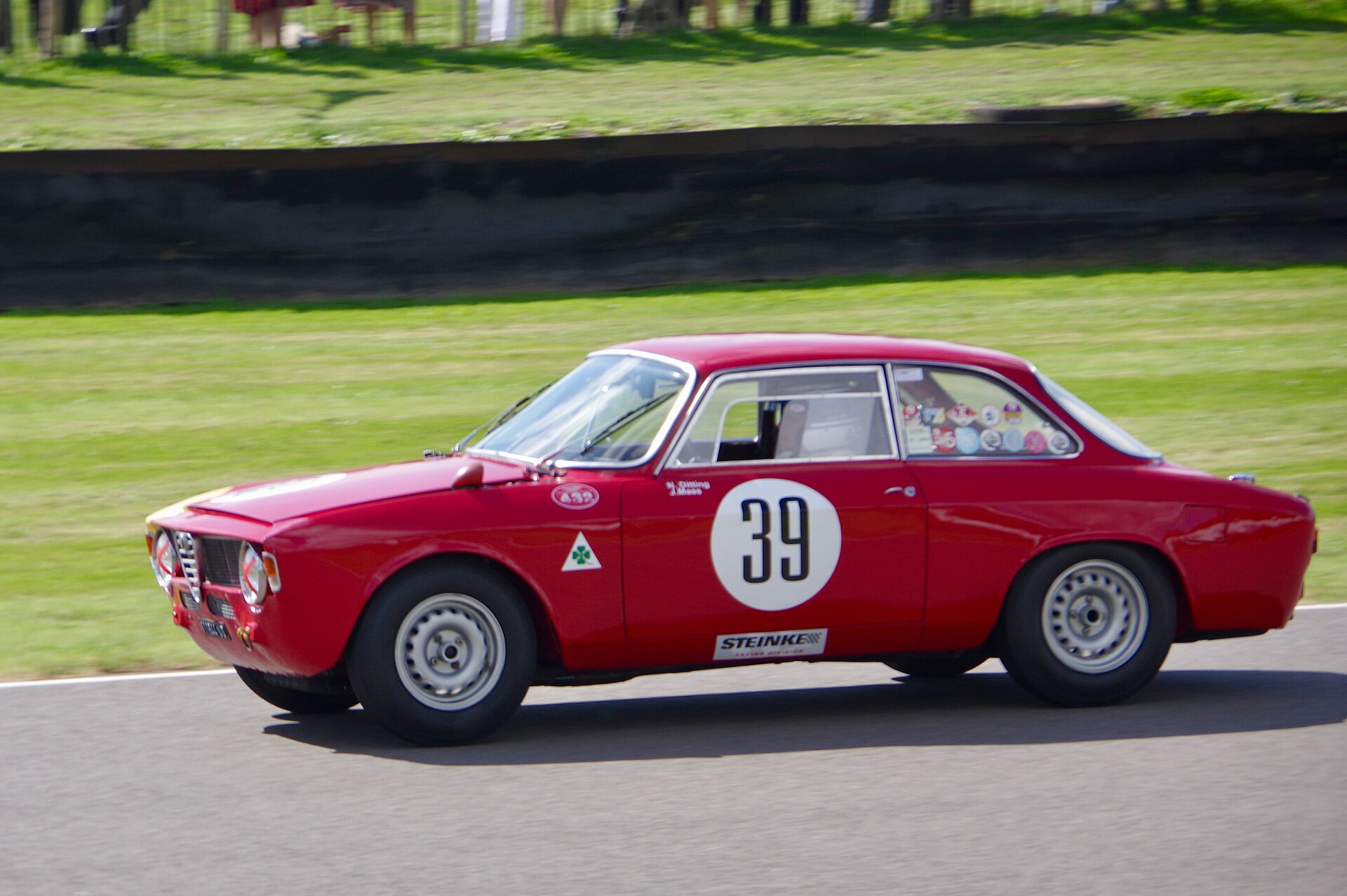
If the TZ was overtly specialised, the Giulia Sprint GTA made Autodelta's work legible to ordinary Alfa owners. Introduced in 1965, it retained the form of the Bertone-designed Giulia Sprint GT while pursuing lower weight and racing suitability. The “A” referred to alleggerita—lightened—and the transformation extended beyond fitting a more powerful engine. Materials, preparation, suspension, gearing and the detail work required for competition all contributed.
The FIA Historic Database records the 1,570 cc, rear-wheel-drive Giulia Sprint GTA under homologation number 199, dated 2 June 1965. That document is useful because homologation places the car in a regulatory context: Autodelta could develop a formidable touring car, but it still had to begin with an eligible model and work within the category's rules. Alfa's heritage account credits the GTA with three consecutive European marque challenges as well as extensive national and individual success.
Smaller-capacity GTA derivatives broadened the programme, and customer teams helped put the cars in front of audiences far beyond Italy. The result was unusually direct brand communication. Spectators could see a car whose roofline and grille belonged to the Giulia family, then visit a showroom selling something recognisably related. Autodelta made the road-to-race connection visible without pretending that a road Sprint GT and a fully prepared competition GTA were the same machine.
Tipo 33: from touring cars to sports prototypes
In 1967 Alfa Romeo and Autodelta entered the sports-prototype arena with the Tipo 33 programme. This was a larger technical and organisational challenge than developing a touring car: purpose-built chassis, engines, aerodynamics and endurance-racing reliability had to advance together. The first 33/2 won at Fléron in Belgium on its competitive debut, and later versions gathered significant class results at major endurance races.
The programme matured over several seasons rather than proceeding in one clean step. Different 33s used different chassis, bodies and engines, so “Tipo 33” should be understood as a developing family, not a single specification. Nor should the rare 33 Stradale road car be treated as a road-registered copy of every racing 33. It expressed the programme's engineering and visual ideas in a different vehicle with a different purpose.
Autodelta's peak world-level results came with the flat-twelve prototypes. Alfa Romeo records the 33 TT 12 as winner of the 1975 World Championship for Makes and the 33 SC 12 as winner of the 1977 championship for sports cars. Naming the exact car, year and championship is more informative than rolling unlike races and titles into one giant total.
A department larger than three famous cars
Autodelta eventually managed a much wider range of Alfa competition work, from one-make and touring-car activity to Formula One. It also served as a testing ground for drivers including Andrea de Adamich, Arturo Merzario, Bruno Giacomelli, Mario Andretti and Jacky Ickx. Not every project reached production or a starting grid. The mid-engined Alfasud Sprint 6C prototypes of the early 1980s show that experimentation remained part of the department's role even when Alfa chose another competitive direction.
Carlo Chiti left in 1984, and Alfa Romeo's official history dates Autodelta's closure to 1985. That ending should not be mistaken for the end of Alfa competition engineering: later cars such as the 155 and 156 created their own successful chapters under different structures. Autodelta's particular legacy was the model it established—focused engineers working close to, but with useful independence from, a large manufacturer.
That is why the blue triangle still carries meaning. It identifies an organisation rather than a trim level: the people who converted Alfa's production knowledge into category-winning touring cars, developed an evolving family of sports prototypes and made racing a working laboratory rather than a decorative story attached after the fact.
Sources
- Alfa Romeo, “Quadrifoglio and Autodelta anniversaries” — official chronology for the 1963 foundation, 1965 acquisition, major programmes and closure. Accessed 2026-08-14.
- Stellantis Heritage, “Tribute to Autodelta” — Giulia TZ construction, debut and competition context. Accessed 2026-08-14.
- FIA Historic Database, Alfa Romeo Giulia Sprint GTA — homologation number, category, capacity and date. Accessed 2026-08-14.
- Alfa Romeo centenary history — broader company and competition chronology, including the 1975 and 1977 championships. Accessed 2026-08-14.
Manufacturer heritage material is a primary source for Alfa Romeo's own chronology but can be promotional. FIA homologation data was used where the regulatory record adds precision. No text from the former italiancar.net article was reused.