Abarth 595: the small car that refused to know its place
Take the cheapest car Italy made, add a great deal of engineering and rather more confidence, and you get one of the most charming performance cars ever built. The 595 is the Abarth story in miniature — literally.
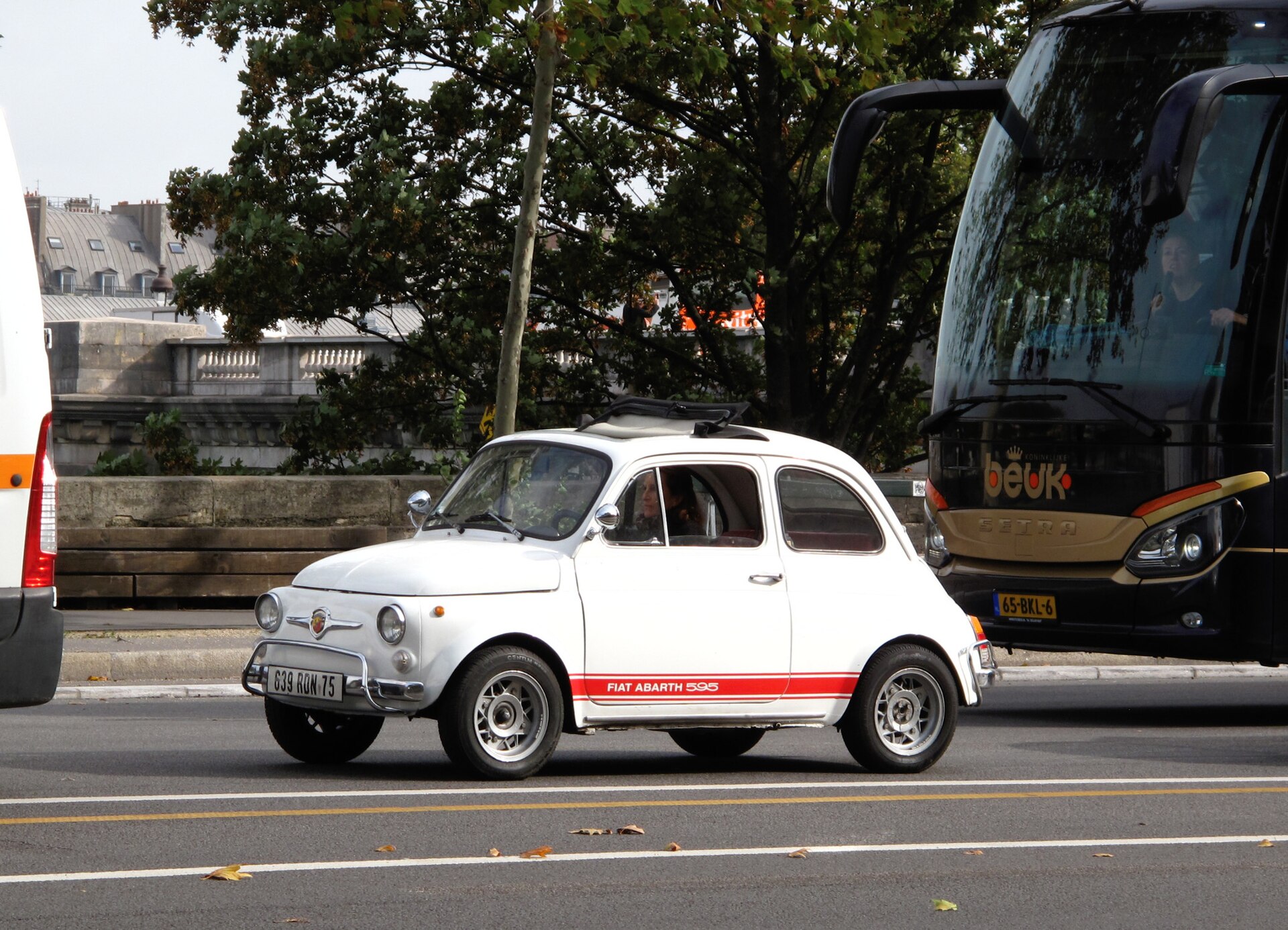

The Fiat 500 was designed to put Italy on wheels as cheaply as physics and economics would allow. It was tiny, air-cooled, rear-engined, and powered by a two-cylinder engine of famously modest output. It was never intended to be quick, and in standard form it emphatically was not.
What Carlo Abarth saw in it was not a fast car. It was a light car — and lightness is the one advantage that no amount of money can easily buy back later.
What Abarth actually changed
The 595 was not a 500 with a badge. The essential work was in the engine: increased capacity, substantially revised breathing, a different carburettor, and the sort of attention to cam profile and compression that separates a tuning kit from a marketing exercise.
The results were transformative in the way only small, light cars can be. A modest increase in absolute power against a very low kerb weight produces a change in character far greater than the numbers suggest. The 595 did not merely go faster than a 500; it felt like a fundamentally different proposition.
Supporting changes mattered as much as the engine. Uprated brakes, revised suspension settings and — a detail every enthusiast knows — the propped-open engine lid, held ajar to force cooling air into a compartment that was never designed to dissipate this much heat. It became a visual signature of the fast Abarths, and it was entirely functional.
595, 595 SS, 695 — decoding the names
This is where most confusion arises, and where most misdescription happens in the classifieds.
The naming follows engine capacity. The 595 designation refers to a nominal capacity a little under 600cc; the 695 to a larger version again. Within each, the SS suffix denotes the higher-output specification — sharper cams, better breathing, more compression, and correspondingly less tolerance for neglect.
There were also Assetto Corsa competition-oriented specifications, with more aggressive settings and equipment aimed squarely at racing rather than road use.
| Layout | Rear-mounted engine, rear-wheel drive |
|---|---|
| Engine | Air-cooled two-cylinder, Abarth-developed from the Fiat 500 unit |
| Capacity classes | 595 (approx. 590–600cc) and 695 (approx. 690cc) |
| Output tiers | Standard and SS, with competition Assetto Corsa specifications above |
| Cooling detail | Rear lid propped open to increase airflow |
| Production era | 1960s, alongside the Fiat 500 it was based on |
What it is like to drive
Slow cars driven quickly, the old argument goes, are more fun than fast cars driven slowly. The 595 is the definitive case for the prosecution — except that in period, on the roads it was built for, it was not really slow at all.
The engine is noisy in a way modern buyers underestimate. It sits behind you, it is air-cooled, and it is working hard. This is not refinement; it is involvement, and the distinction matters enormously to how you will feel about the car after two hours.
The handling rewards commitment and punishes clumsiness. A rear-engined layout with this weight distribution behaves exactly as physics predicts: turn-in is eager, and lifting off mid-corner shifts the balance in ways that reward a driver who has thought about it in advance.
Buying: what actually matters
Provenance above all
This is the single most important paragraph on this page. Genuine Abarth cars are worth substantially more than Fiat 500s converted later, and the gap creates obvious incentives. Conversions range from honest, well-executed tributes openly described as such, to cars misrepresented as factory originals.
Documentation, chassis records and recognition by a marque registry are worth more than any individual component. If a seller is vague about history on a car of this value, treat the vagueness as the answer.
Rust, in the usual places and some unusual ones
Structural corrosion is the expensive problem: floors, sills, suspension mounting points and the front luggage area. Cosmetic rust is a nuisance; structural rust in a monocoque this small can exceed the car's value to put right properly.
Engine condition and heat
These engines run hot by design and hotter when tuned. Evidence of overheating, poor cooling-system maintenance, or a rebuild of unknown quality should all reduce your offer. Correct Abarth components are increasingly scarce and correspondingly expensive.
Originality of the small parts
Instruments, carburettor, exhaust and interior trim are the details that separate a good car from an expensive project. They are also the parts most often quietly substituted.
Why it still matters
The 595 is the purest expression of what Abarth was for. It took a car built to a price for people without much money, and made it thrilling without making it expensive to buy in the first place. That is a genuinely democratic idea about performance, and it is rarer in motoring history than it should be.
Fiat revived the name for the modern era, and the modern 595 is a competent hot hatch with a good badge. But the original did something the revival cannot: it made a fundamentally humble object into something exciting, rather than making an already-sporting car more so.