Fiat Abarth 750 Zagato: form following function, twice
Two bulges in a roof turned an efficient little coupé into one of the most recognisable shapes of the 1950s. The reason they are there says everything about how Italian racing cars were actually built.
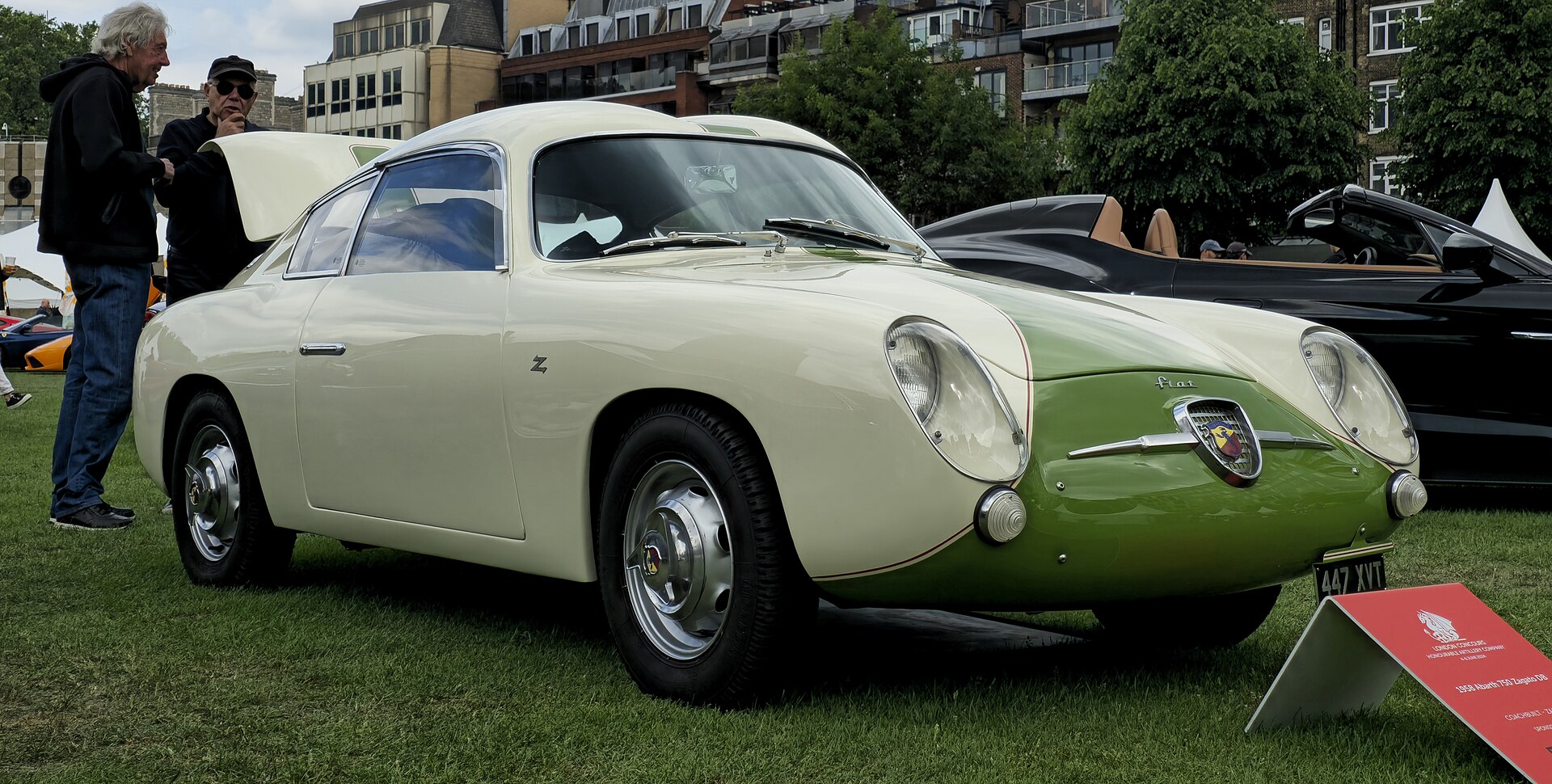

Abarth's genius was making small engines produce improbable power. Zagato's was making light bodies that cut through air. The 750 Zagato is what happened when those two obsessions met on top of Fiat's 600 platform, and the result outlived both companies' expectations for it.
Why the roof has bubbles
The doppia gobba — double-bubble — is the detail everyone remembers, and it is almost universally misunderstood as styling. It is not.
Zagato built light bodies. Lightness came from thin-gauge aluminium panels, and thin panels over a large flat area are structurally weak and prone to drumming. A curve is stiffer than a flat sheet. Two domes over the occupants' heads therefore did two things simultaneously: they added the rigidity a flat roof would have lacked, and they bought headroom for a helmeted driver without raising the whole roofline and with it the frontal area.
Lower roof, more head room, stiffer panel, less weight. The double-bubble is not decoration that happens to work. It is engineering that happens to look extraordinary.
That it became a Zagato signature — applied across decades and marques — is a consequence of how well it solved the problem, not of how it looked. Though it must be said that it looked, and looks, superb.
The mechanical package
Underneath is the Fiat 600's rear-engined layout, comprehensively reworked. Abarth increased capacity to the nominal 750cc that gives the car its name, with the breathing and camshaft work that characterised all of the firm's serious engines.
The combination is the point. A modest-output engine in a body that is both very light and genuinely aerodynamic produces performance that neither element could deliver alone — and, critically for Abarth's purposes, does so in a capacity class where it faced far less well-funded opposition.
| Base | Fiat 600 floorpan and running gear |
|---|---|
| Layout | Rear engine, rear-wheel drive |
| Engine | Water-cooled four-cylinder, Abarth-developed, nominal 750cc class |
| Body | Aluminium coupé by Zagato, double-bubble roof |
| Era | Later 1950s |
| Purpose | Class competition and fast road use |
Record-breaking, and why it mattered commercially
Abarth invested heavily in long-distance record attempts — runs where a car circulates at sustained speed for many hours. For a firm whose income came from selling tuning parts, these were the ideal advertisement. A race win could be luck or attrition. A multi-hour record run proved the engine would not destroy itself, which was exactly the anxiety a prospective customer had about buying tuning parts.
The small, slippery, aerodynamically-bodied cars were well suited to this work, and the results fed straight back into the catalogue.
Buying one
Aluminium changes everything
An alloy body does not rust as steel does, but it corrodes electrolytically where it meets steel structure, and it work-hardens, cracks and fatigues around mounting points and stress areas. Repair demands a specialist with the right skills — a competent steel panel shop is not a substitute.
Individual variation is normal
These were low-volume coachbuilt cars. Panel fit, detail trim and minor dimensions differ between examples, and period repairs are common. Variation is not automatically evidence of inauthenticity, which unfortunately also makes inauthenticity harder to detect.
Documentation is the asset
With values at this level and bodies that can be recreated by a skilled panel-beater, history is what you are actually buying. Chassis records, competition history and registry recognition carry the value. Treat an undocumented car as a very different, much cheaper proposition.