Model guide
Alfa Romeo 147: a compact car with an unreasonable brief
The 147 had to replace two hatchbacks, carry Alfa Romeo's new design language into a smaller class and feel distinct from the Fiat products around it. Its 2001 European Car of the Year award suggests how convincingly it did the job.
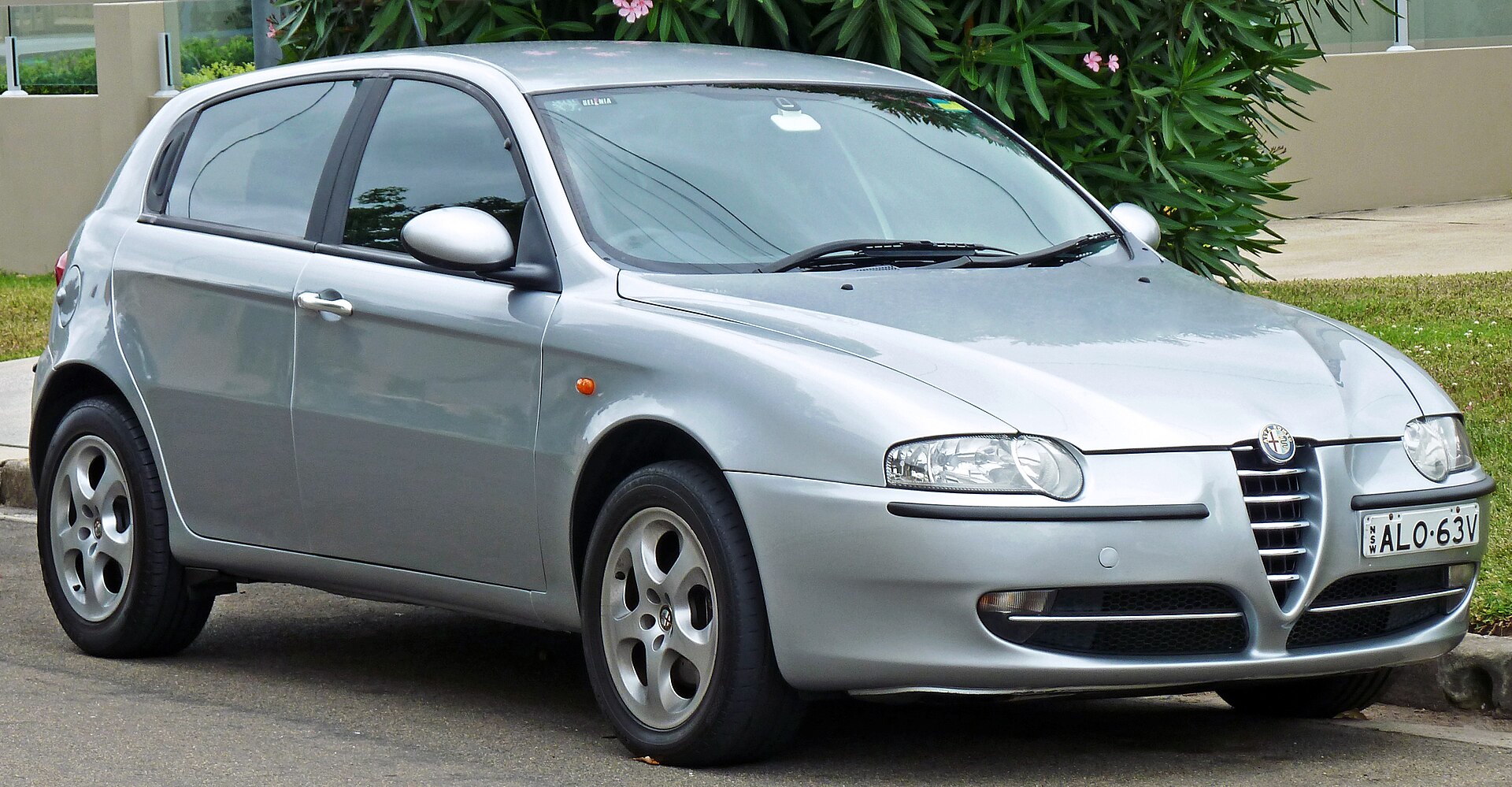

Alfa Romeo presented the 147 in 2000 as the successor to both the 145 and 146. Mechanically it belonged to the same broad family as the 156, but the point was not merely to shorten that saloon and add a hatch. The 147 used proportion, surface and cabin design to make a relatively conventional front-drive layout feel like a deliberate Alfa rather than a group-platform obligation.
The public response was immediate. It won the 2001 European Car of the Year award, following the 156's victory three years earlier. Alfa's later account says the model collected 27 awards in its first three years; that is a manufacturer tally, but the major European prize is independently documented by the award organisation.
Design: the 156 idea, tightened
The 147 was developed by Centro Stile Alfa Romeo. Its shield grille, offset front number plate and rising shoulder line made the family relationship with the 156 obvious, while the hidden rear-door handles let the five-door retain the visual simplicity of the three-door. Inside, deeply cowled instruments and a centre console angled toward the driver reinforced the same message.
That identity mattered because the underlying ingredients were not exotic: a transversely mounted engine, front-wheel drive and a hatchback body. Alfa concentrated the differentiation where an owner would notice it every day—in steering response, seating position, instrumentation and the way the car met the road.
Engines and the everyday range
European cars were offered with Twin Spark petrol engines and JTD diesels in several outputs, with availability varying by market and year. A five-speed manual covered much of the range; some petrol versions used Alfa's automated-manual Selespeed transmission. The later Multijet diesels broadened both power and torque as common-rail technology developed.
A used-car advertisement is not enough to establish a 147's original specification. Market equipment differed, engines evolved during the model's life and badges are easily changed. A chassis-number check against market-specific parts or build records is more useful than a generic online table.
The 147 GTA: too much engine, exactly on purpose
The GTA arrived with the 3.2-litre, 24-valve V6 also used in the 156 GTA. Alfa's period material quoted 250 bhp and 300 Nm. It drove the front wheels through a six-speed gearbox, with either a conventional manual or Selespeed depending on market. Larger brakes, a wider track, revised suspension and substantially changed bodywork were not optional decoration; they were the work required to put that engine in a compact hatchback.
On paper, sending this output through the front axle invited obvious questions. In practice, the GTA's appeal was never that it offered the tidiest possible engineering solution. It paired one of Alfa's defining engines with the smallest contemporary body that could reasonably contain it. The result was charismatic, demanding and distinct from the turbocharged four-cylinder formula that later came to dominate fast hatchbacks.
| Engine | 3,179 cc naturally aspirated 24-valve V6 |
|---|---|
| Factory output | 250 bhp; 300 Nm |
| Drive | Front-wheel drive |
| Transmission | Six-speed manual; Selespeed offered in some markets |
| Body | Three-door hatchback |
The 2004 revision
Alfa announced the revised 147 in 2004. A deeper shield grille and reshaped lamps made the nose closer to the then-new 159 and Brera direction, while the rear lights and cabin details also changed. The range gained newer JTD Multijet variants and revisions to equipment and suspension. Alfa said more than 360,000 buyers had chosen the 147 before this update, placing the restyle in the middle of an already successful production run rather than as a rescue.
What matters now
The 147's age makes condition more important than a fashionable trim level. Service history for the timing drive, cooling system and suspension is central on petrol cars; diesel intake, turbo and emissions hardware require model-specific inspection. Selespeed cars need diagnosis by someone who understands the hydraulic and electronic system, not a guess based on how the gear indicator behaved during one drive.
For the GTA, originality and evidence of careful maintenance matter particularly. The model's power, age and values encourage modifications; some are worthwhile, but they must be declared and assessed as a system. This guide cannot authenticate a car or replace an inspection.
Why the 147 belongs in the archive
The 147 is a useful correction to the idea that character requires an unusual layout. Its structure was rational and its market position mainstream. Alfa made it memorable through the accumulated detail of design, controls, engine choices and response. The GTA then proved how far that platform could be pushed before reason became part of the entertainment.
Sources and further reading
- Alfa Romeo, “Alfa 147” launch material.
- Alfa Romeo, revised 147 press material (2004).
- Alfa Romeo UK, 147 GTA market introduction and specifications.
- Car of the Year, 2001 winner: Alfa Romeo 147.
Sources accessed 14 August 2026. Manufacturer heritage material is used for period specifications and checked against the independent award record where relevant.