Model guide
Alfa Romeo 156: the saloon that reset the marque
The 156 made a practical four-door look like a coupé, brought common-rail diesel to series-production passenger cars and gave Alfa Romeo its first European Car of the Year victory.
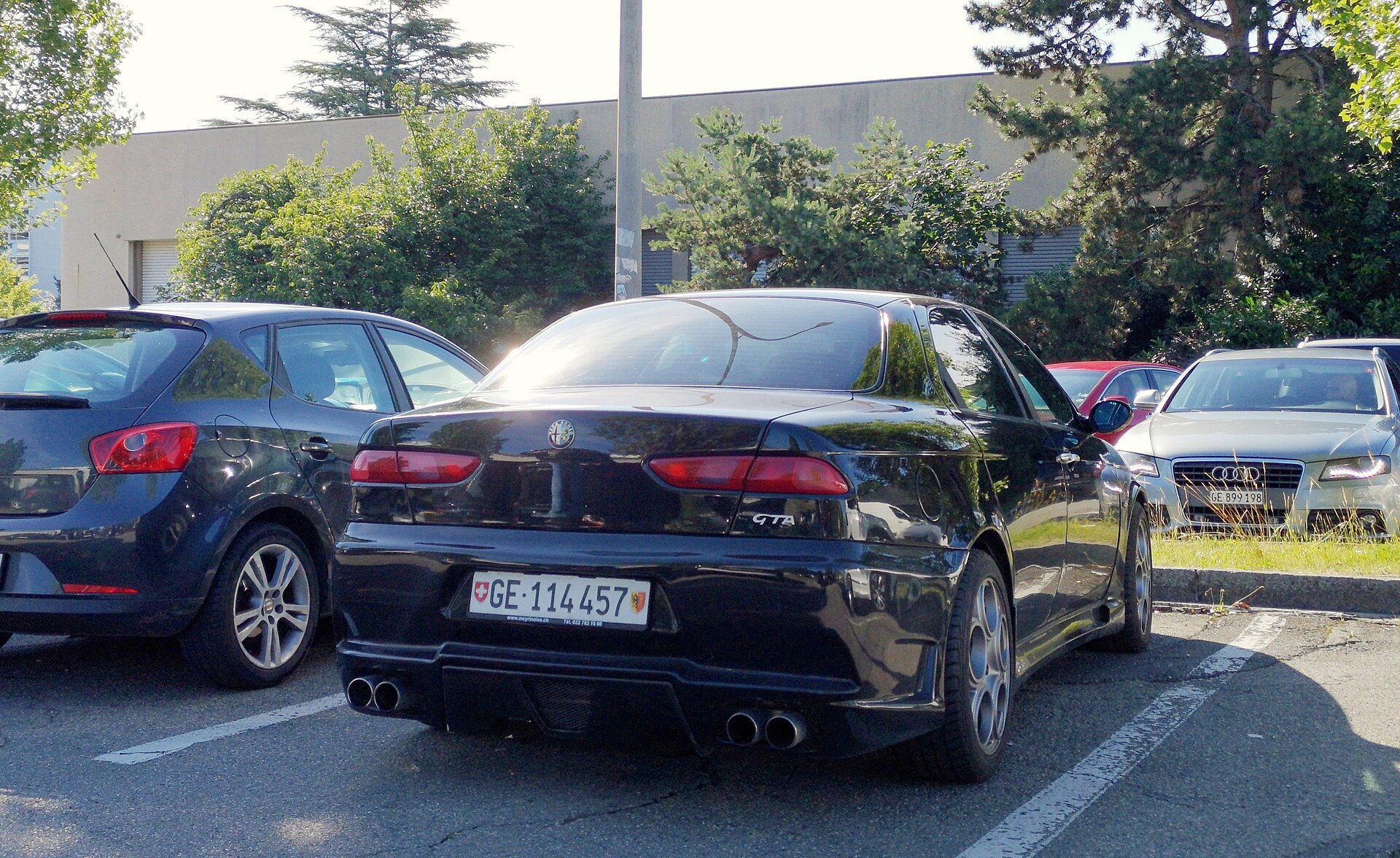

When Alfa Romeo revealed the 156 at Frankfurt in 1997, it needed more than a replacement for the 155. The new car had to make the case that an Alfa saloon could again be chosen for desire rather than explained away as a compromise. It succeeded because its design, engines and road behaviour told the same story.
The 156 won the 1998 European Car of the Year award—the first Alfa Romeo to do so. That prize is not merely a retrospective design compliment: it records how strongly the car landed with contemporary jurors against the market of its own moment.
A four-door that concealed the argument
Walter de Silva led the Centro Stile Alfa Romeo team responsible for the original shape. The front door handles were emphatic metal objects; the rear handles disappeared into the window frames. A high waist, shield grille and abbreviated tail then made the saloon read as something lighter and more compact than its actual package.
The interior repeated the driver-focused theme with cowled instruments and a console angled inward. None of these devices made the structure exotic, but together they gave a mass-produced transverse-engine saloon a clear identity. The 147 later adapted this language; many newer Alfas still quote it.
The JTD significance
The 156's most consequential engineering first was easy to overlook beside its styling. Alfa offered the 1.9 and 2.4 JTD using electronically controlled common-rail direct injection. In its period material, Alfa describes the 156 JTD as the first production car with this diesel system. Common rail separated pressure generation from individual injection events, allowing more precise fuel delivery than older passenger-car diesels.
That mattered beyond economy. The technology helped make diesel engines quieter, more flexible and more compatible with the performance expectations of a car like the 156. It subsequently spread across the industry. As always, a manufacturer statement about a first should be read with its definition—series-production passenger car and modern electronically controlled common rail—made explicit.
Petrol engines, Selespeed and the expanding range
Twin Spark four-cylinders formed the petrol core, joined by Alfa's 2.5-litre V6. A conventional manual was the reference transmission; the automated-manual Selespeed brought steering-wheel control derived in concept, though not hardware, from racing practice. It delivered a distinctive experience but now requires specialist diagnosis and documented maintenance.
The Sportwagon arrived in 2000. Alfa positioned it as a sporting alternative rather than as the maximum-volume estate in the class, and the tapered rear reflected that choice. Crosswagon Q4 later added a raised body and all-wheel drive to a diesel Sportwagon, a niche branch that deserves to be distinguished from ordinary front-drive estates.
JTS and the 2003 restyle
The 2.0 JTS introduced petrol direct injection to the range, replacing the 2.0 Twin Spark in many markets. Its initials stood for Jet Thrust Stoichiometric; the important ownership point is simpler: it is a different engine family with different maintenance concerns, not merely a later tune of the Twin Spark.
Giorgetto Giugiaro reshaped the nose and tail for the 2003 revision. The deeper grille and more formal lamps aligned the 156 with the emerging 159 generation while leaving the original body centre intact. Whether the restyle improved de Silva's resolved first version is subjective; it clearly separates late cars at a glance.
The 156 GTA
Introduced in 2001, the GTA used a 3.2-litre 24-valve V6 rated at 250 bhp and 300 Nm, driving the front wheels through six-speed manual or Selespeed transmissions depending on market. Wider tracks, firmer suspension, larger brakes and muscular bodywork turned the base car into something more than an engine option.
| Engine | 3,179 cc naturally aspirated 24-valve V6 |
|---|---|
| Factory output | 250 bhp; 300 Nm |
| Drive | Front-wheel drive |
| Bodies | Saloon and Sportwagon |
| Transmission | Six-speed manual; Selespeed in selected markets |
Like the smaller 147 GTA, it did not attempt to imitate a rear-drive German sports saloon. Its front-drive layout asked the chassis and tyres to manage substantial output, and that tension is part of the car's identity. Later limited-slip differential conversions are common; their quality and effect must be assessed on the individual car.
Buying one now
A 156 should be bought on structure and evidence, not paint shine. Inspect floors, sills and jacking points; examine front suspension wear; establish when the timing drive and water pump were serviced on relevant petrol engines; and diagnose warning lights rather than clearing them. Diesel, JTS, Selespeed, Q4 and GTA versions each add systems that demand the right specialist.
Early cars are now old enough that deferred maintenance can exceed their purchase price. Conversely, a well-documented ordinary 1.8 or 2.0 can express the design and steering qualities that made the 156 important without the GTA's cost or authentication questions.
Its place in Alfa history
The 156 did not rescue Alfa Romeo single-handedly, and it did not reverse every commercial problem that followed. It did restore a recognisable idea of an Alfa saloon: distinctive before the engine started, responsive once it moved, and technically interesting where a mainstream buyer could use it. The 147, GT and later 159 all began from the territory it reopened.
Sources and further reading
- Alfa Romeo, “Alfa 156: 1998 Car of the Year”.
- Alfa Romeo UK, 156 background and range history.
- Alfa Romeo, 156 design and engineering history.
- Car of the Year, 1998 winner: Alfa Romeo 156.
Sources accessed 14 August 2026. Period specifications are presented in their factory units; individual-market cars can differ.