Model guide
Ferrari F430: where software became part of the supercar
The F430 retained the aluminium, mid-engined template of the 360 but changed the engine, aerodynamics and controls. Its electronic differential and steering-wheel manettino made chassis software something the driver actively selected.
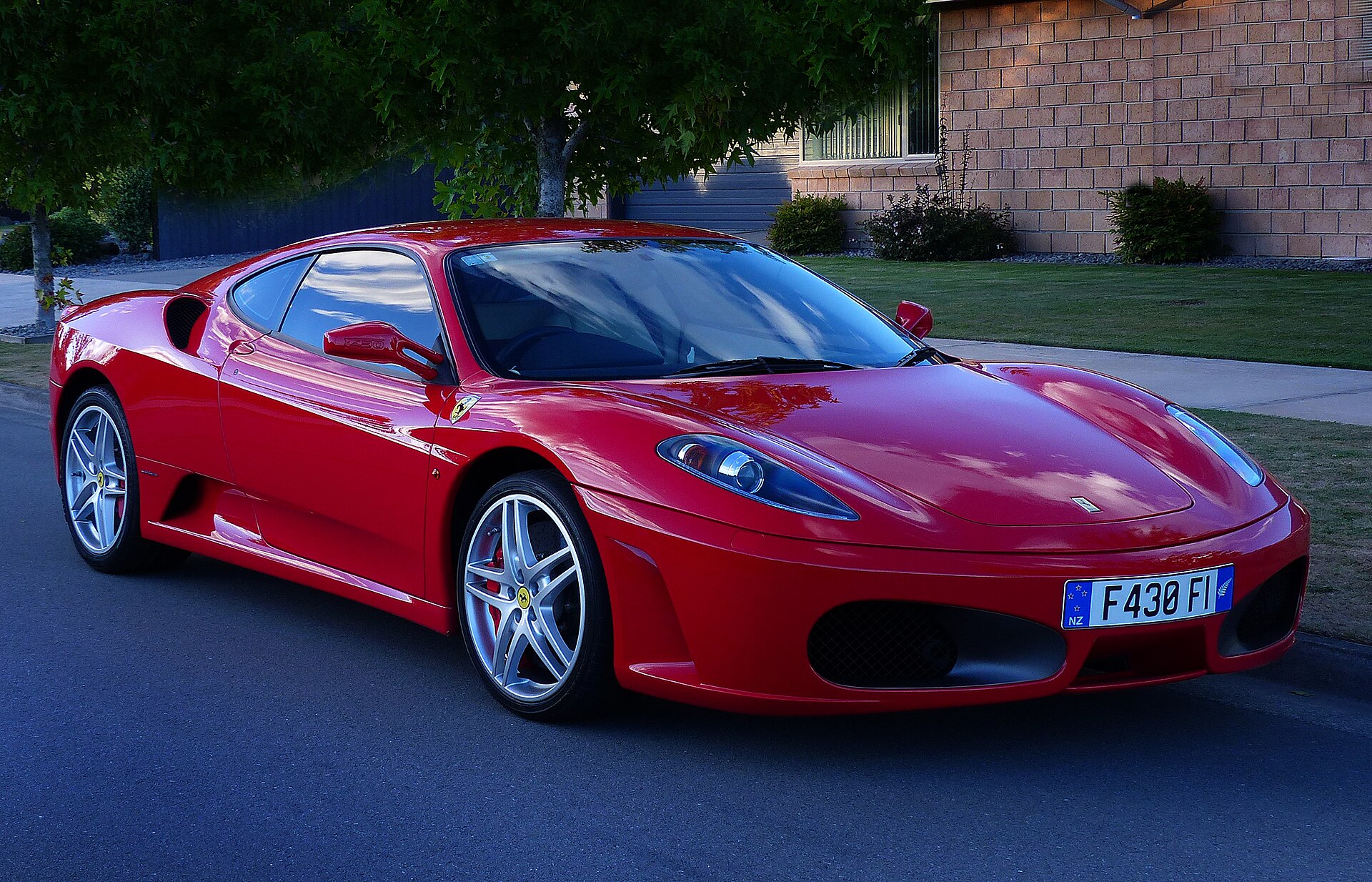

Ferrari unveiled the F430 in 2004 as the successor to the 360 Modena. The resemblance between them can hide the scale of the engineering change. Both used an aluminium structure and placed a naturally aspirated V8 behind the occupants, but the F430's 4.3-litre engine belonged to a new family and its electronic systems altered how the driver interacted with the chassis.
The model also sits at an informative point in Ferrari history. A conventional open-gate manual was still available, while the electrohydraulic F1 transmission represented the direction demand was taking. Analogue hardware and increasingly integrated control software coexisted in the same catalogue.
A new V8, not a bored-out 360 engine
The 4,308 cc, 90-degree V8 produced a factory-rated 490 CV at 8,500 rpm and 465 Nm at 5,250 rpm. Ferrari quoted 0–100 km/h in 4.0 seconds and a maximum speed above 315 km/h. More important than the headline figures was the engine's breadth and its relationship with the new chassis controls.
| Engine | 4,308 cc naturally aspirated 90° V8 |
|---|---|
| Factory output | 490 CV at 8,500 rpm; 465 Nm at 5,250 rpm |
| Drive | Rear-wheel drive, mid-mounted engine |
| Transmissions | Six-speed manual or six-speed electrohydraulic F1 |
| Factory performance | 0–100 km/h in 4.0 s; over 315 km/h |
Ferrari's catalogue uses CV, the metric horsepower unit. It should not be silently relabelled as bhp: conversions vary slightly, and preserving the factory unit avoids false precision.
E-Diff and manettino
The electronic differential, or E-Diff, was the F430's defining road-car technology. Rather than relying only on a fixed mechanical locking strategy, it used hydraulic control and data from the car's other systems to vary the distribution of torque across the rear axle. Ferrari had developed related ideas through Formula One, but the road-car achievement was integration, not simply transplantation.
The steering-wheel manettino gave the driver a visible way to select modes governing stability control, damping where fitted, throttle response, transmission behaviour and E-Diff strategy. Later Ferraris made such controls familiar; in the F430 they were a central part of the model's identity. Software was no longer a hidden calibration behind the engine—it was part of the driving interface.
Form following air
Pininfarina styled the F430 in collaboration with Ferrari. The twin front intakes referenced the 1961 156 F1 “sharknose,” but they also fed a more sophisticated aerodynamic package. The flat floor, rear diffuser and carefully managed airflow aimed to increase downforce without relying on a conspicuous fixed wing on the standard car.
The transparent engine cover and four round tail lamps made the relationship with the 360 clear. Larger intakes, a different rear treatment and the pronounced diffuser signalled what had changed beneath it.
F430 Spider
Ferrari introduced the open F430 Spider in 2005. Its folding soft top and structural changes brought a weight penalty, while the exposed cabin made the V8 a still larger part of the experience. It was not merely a roof mechanism added to a berlinetta: cooling, aerodynamics and structure had to work around the altered body.
When comparing cars, use the correct body-specific data. Performance, weight and luggage details from the coupé should not be copied into a Spider listing without verification.
430 Scuderia and 16M
The 430 Scuderia, presented in 2007, pursued lower mass, faster shifts and sharper control calibration. Ferrari rated its V8 at 510 CV. The transmission's shift time was reduced, while the E-Diff and traction functions were brought together through the E-Diff2 system. The point was not simply twenty additional CV; it was the coordination of mass, response, grip and controls.
The open Scuderia Spider 16M followed as a limited celebration of Ferrari's 2008 Formula One constructors' title. Its name belongs to that specific commemorative model, not to every modified F430 Spider.
Ownership questions
A pre-purchase inspection must identify the exact transmission, brake and suspension specification. Carbon-ceramic brake condition, clutch wear on F1 cars, exhaust manifolds, engine mounts, sticky interior finishes and evidence of accident repair can all materially change the cost of ownership. Diagnostic data is useful, but it does not replace physical inspection or service invoices.
Manual cars are scarce and command a market premium. That makes provenance especially important: the existence of aftermarket manual conversions means a gated lever alone does not establish factory configuration. Ferrari build records and consistent documentation should lead the assessment.
Why the F430 matters
The F430's importance is not that it was the first computer-controlled performance car. It is that Ferrari made integrated electronic control legible and desirable to the driver while retaining a high-revving naturally aspirated engine and, briefly, the option of a traditional manual. It marks the point where software stopped sounding like an intrusion and became part of the Ferrari vocabulary.
Sources and further reading
- Ferrari, F430 official model archive.
- Ferrari, mid-engined V8 bloodline.
- Ferrari, F430 technology retrospective.
- Ferrari, F430 Spider official archive.
- Ferrari, 430 Scuderia official archive.
Sources accessed 14 August 2026. Factory performance is reported as claimed, not as an independent road-test result.