Design profile
Pininfarina: from coachbuilder to design institution
One family name became shorthand for Italian automotive form. The important history lies not in a list of beautiful cars, but in how Pininfarina joined design, craft, aerodynamics and industrial production.
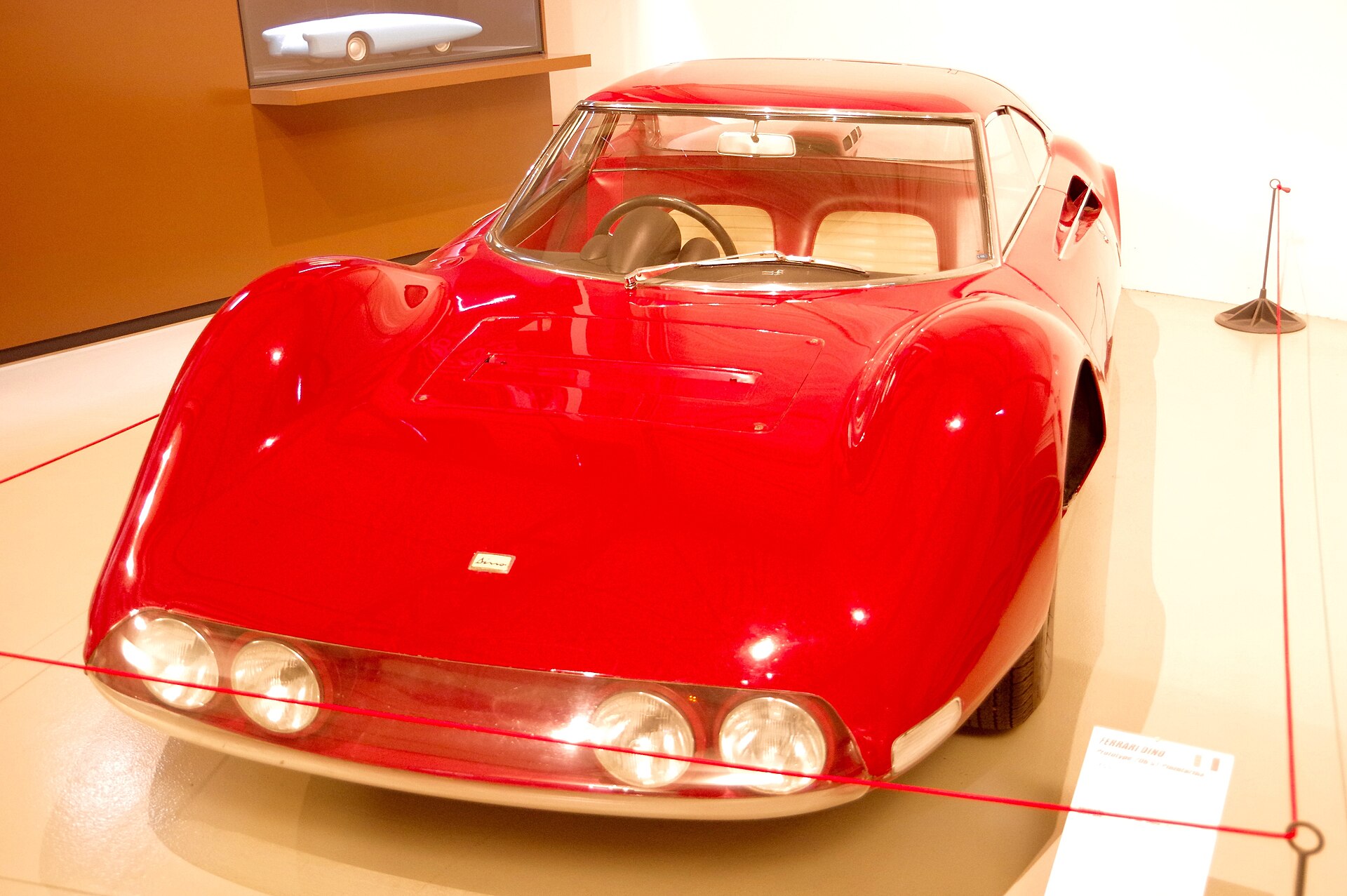

Battista Farina founded Carrozzeria Pinin Farina in Turin in 1930. “Pinin” was his nickname; Farina was the family name. In 1961 an official change joined them as Pininfarina, turning the founder's personal identity into the company name recognised today.
The firm began within the coachbuilding tradition: a specialist could clothe a manufacturer's chassis, sometimes in tiny numbers and sometimes as the prototype for a production design. Pininfarina's long-term distinction was its ability to move beyond that craft model without abandoning it, developing engineering, aerodynamic research and manufacturing capacity alongside styling.
The Cisitalia 202 and the single-volume idea
The Cisitalia 202 of 1947 is the clearest early statement. Its bonnet, wings and passenger compartment read as a continuous volume instead of as separate components attached to a chassis. That visual integration now seems normal because designs like the 202 helped make it normal.
New York's Museum of Modern Art included the Cisitalia in its landmark 1951 exhibition 8 Automobiles; the car is now in MoMA's collection. Museum status does not prove a car is mechanically superior, but it shows that automotive form was being evaluated as modern design rather than dismissed as commerce.
Ferrari: a partnership, not a single author
Pinin Farina and Enzo Ferrari began their formal relationship in the early 1950s. Over the following decades, Pininfarina shaped a large part of Ferrari's road-car identity—from front-engined grand tourers to mid-engined berlinettas. The partnership became so familiar that “Pininfarina Ferrari” can sound like a single category.
Attribution still requires care. A car may carry a Pininfarina badge while the detailed work involved an individual designer, Ferrari's engineers, aerodynamic development and production changes. Some bodies were built by Pininfarina; others were styled there and manufactured elsewhere. “Designed by,” “built by” and “engineered with” are not interchangeable.
The long relationship included the 250 GT family, 365 GTB/4, Testarossa, F40 and many later models. The F430 was styled by Pininfarina in collaboration with Ferrari; subsequent Ferrari design increasingly moved in-house. That transition changed the business relationship without erasing the visual vocabulary developed over half a century.
Beyond Ferrari
Reducing Pininfarina to Ferrari overlooks much of its influence. The company worked repeatedly with Alfa Romeo, Fiat, Lancia and Peugeot, and on projects for manufacturers far beyond Italy. The Alfa Romeo Spider, Fiat 124 Sport Spider and Peugeot 406 Coupé show three different kinds of longevity: a design can survive because its proportions are strong, because manufacturing adapts around it, or because a maker chooses not to replace an established visual identity.
The work also ranged beyond rare cars. Designing for large production volumes imposes constraints of tooling, repair, visibility, luggage space and regulation that a one-off show car can avoid. Pininfarina's importance comes partly from moving between those worlds.
Wind, engineering and production
In 1972 Pininfarina opened a full-scale wind tunnel at Grugliasco, an unusually significant facility for an independent design company. Aerodynamics could then enter the design process as measured development rather than surface intuition alone.
Pininfarina also manufactured cars in series for client marques. That capacity made the company responsible for turning an idea into repeatable panels, closures and finished vehicles. Styling sketches are the visible end of design history; tolerances, tooling and assembly are the less photogenic work that lets the sketch reach a road.
People behind the name
Battista's son Sergio Pininfarina became a central figure in the company's expansion and in its Ferrari relationship. Renzo Carli, Paolo Martin, Leonardo Fioravanti and other designers and engineers contributed to different periods and projects. A responsible model article should name the individual when documentary evidence supports it, while also recognising the studio and client team.
This is especially important for internet lists that assign every Pininfarina-badged car to one celebrated person. Studio work is collaborative, historical credits can conflict and a chief designer's oversight is not necessarily the same as drawing the selected proposal.
The modern company
The decline of contract coachbuilding and a severe financial crisis changed Pininfarina's structure in the twenty-first century. Mahindra Group acquired a controlling interest in 2015. The company now applies design and engineering work across transport, architecture and products as well as cars.
That is not a simple break with the past. Pininfarina always survived by translating a design identity across changing methods of production. The medium has expanded; the task remains to make form, engineering and manufacture agree.
How to read a Pininfarina credit
Sources and further reading
- Pininfarina, official heritage timeline.
- Museum of Modern Art, Cisitalia 202 GT collection record.
- Museum of Modern Art, Cisitalia 202 design history.
- Ferrari, Pininfarina partnership history.
- Mahindra & Mahindra, 2015–16 annual report: controlling stake in Pininfarina.
Sources accessed 14 August 2026. Project credits should be checked against model-specific records; this page does not assign undocumented individual authorship.