Maserati model guide
Maserati GranSport: the M138 Coupé, sharpened
The GranSport was not a clean-sheet Maserati. It was the most focused factory development of the M138 Coupé: a four-seat grand tourer given more power, revised transmission control, firmer chassis hardware and a clearer sporting identity.
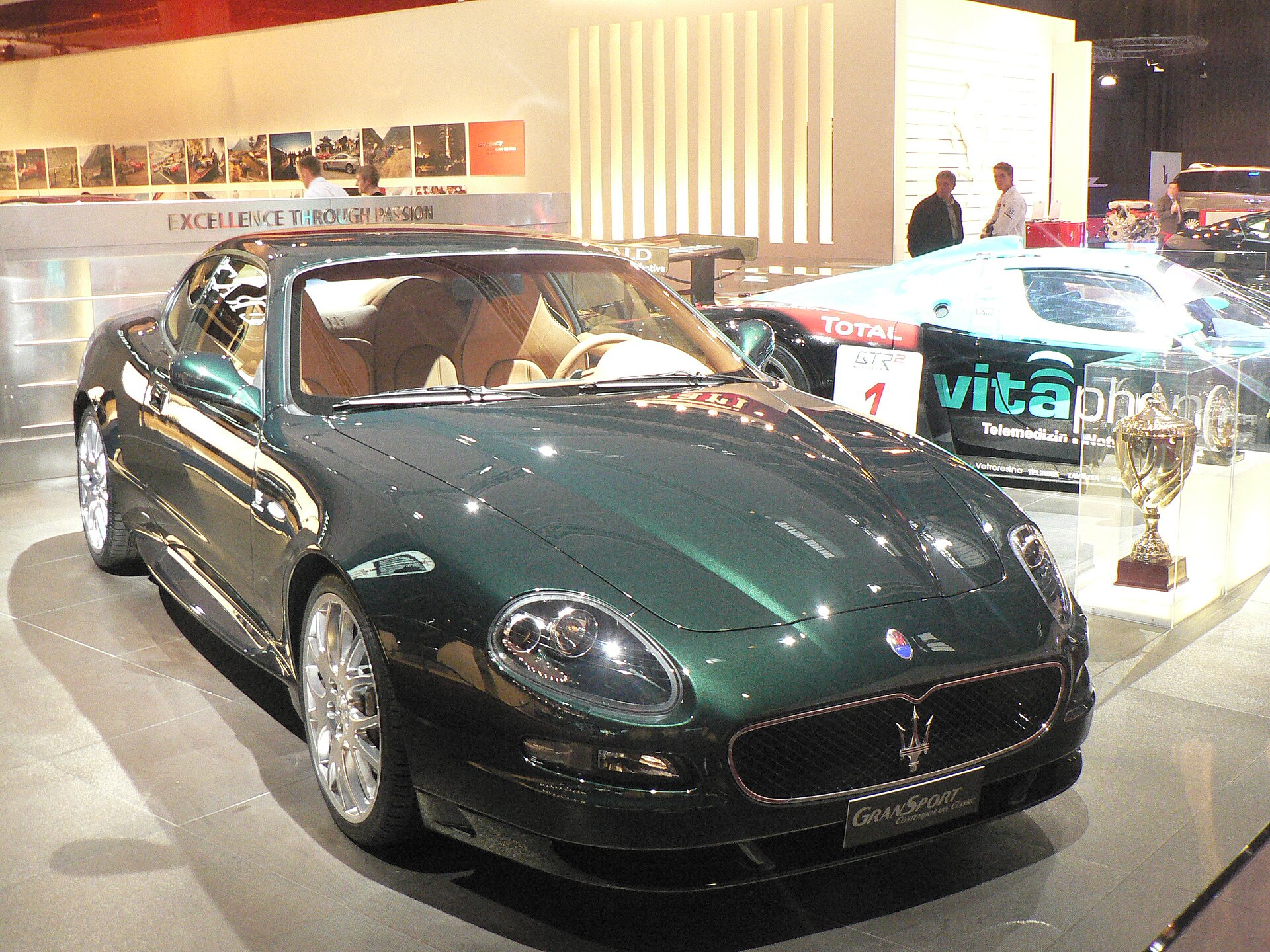

The useful way to understand the Maserati GranSport is to begin one model earlier. Maserati's 2002 Coupé retained the broad form that Giorgetto Giugiaro's Italdesign had created for the 3200 GT, but the factory describes the later car as technically transformed. The twin-turbo V8 gave way to a naturally aspirated 4,244 cc V8, and the transmission moved to the rear as part of a transaxle arrangement. Buyers could choose a conventional manual in the Coupé GT or the electrohydraulically operated Cambiocorsa transmission.
That distinction matters because the GranSport, presented at the Geneva Motor Show in 2004, was an evolution of the Coupé rather than a separate design. Maserati calls it the most dynamic version of the M138 range. The name therefore denotes a coherent factory model, not merely an appearance package or a nickname later applied to an ordinary Cambiocorsa car.
From Coupé to GranSport
The headline power increase was modest: Maserati's current archive lists 390 hp for the Coupé and 400 hp at 7,000 rpm for the GranSport. More revealing is how the changes were distributed across the car. The GranSport received revised engine tuning, updated control logic for the standard Cambiocorsa gearbox, upgraded suspension and new 19-inch wheels. A larger grille opening, a reshaped front bumper and aerodynamic side sills gave the body a more assertive stance without abandoning the original Italdesign proportions.
Inside, the factory fitted new sports seats and a more overtly sporting treatment. None of those items alone remade the M138. Together they shifted its emphasis from rapid luxury coupé toward a car intended to communicate more directly with its driver. That is why reducing the GranSport to its ten additional horsepower misses most of the story.
The V8 and Cambiocorsa layout
Maserati records the GranSport engine as a 90-degree, 32-valve, double-overhead-camshaft V8 with dry-sump lubrication. Dry-sump storage keeps the main oil supply outside a conventional deep sump, useful in a low sporting installation and under sustained cornering forces. The official displacement is 4,244 cc.
Cambiocorsa is best described as an automated manual, not as a torque-converter automatic and not as a modern dual-clutch transmission. Electrohydraulic actuators perform clutch and shift operations, while the gearbox sits at the rear in the M138 transaxle architecture. The GranSport made this transmission standard and used revised software logic. That software is part of the model's identity: its purpose was to make the existing hardware respond in a more sporting way rather than to introduce an entirely new gearbox.
| Public debut | Geneva Motor Show, 2004 |
|---|---|
| Factory production period | 2004–2007 |
| Model code | M138 |
| Body | Two-door, four-seat coupé; Italdesign |
| Engine | 4,244 cc naturally aspirated 90° V8; 32 valves; DOHC; dry sump |
| Factory maximum power | 400 hp at 7,000 rpm |
| Transmission | Cambiocorsa electrohydraulic automated manual; rear transaxle |
| Factory maximum speed | 290 km/h |
| Number produced | 2,640, according to Maserati's current model archive |
GranSport Spyder: related, but not identical
The open version followed at the Frankfurt Motor Show in 2005. Maserati lists the GranSport Spyder as a two-seat car built from 2005 to 2007, not simply a roofless four-seat coupé. Its archive entry gives the same 4,244 cc engine specification and 400 hp maximum, and records 473 examples.
The production dates and body description are useful safeguards when identifying cars. “GranSport” can refer to the coupé or the later Spyder, while “Coupé Cambiocorsa” describes the closely related 390 hp predecessor. The cars share the M138 family and much of their engineering, but those names should not be treated as interchangeable.
What the design tells us
The GranSport also shows how long a strong basic shape can remain useful. Its body still traced back to Italdesign's 3200 GT, yet Maserati had already altered an important signature when preparing the 2002 Coupé. The factory history notes that the 3200 GT's boomerang rear lamps were removed in connection with United States requirements. By the time the GranSport arrived, the visual development concentrated on airflow, stance and detail rather than another wholesale redraw.
This continuity makes the GranSport a layered car. Its exterior belongs to a design programme begun in the late 1990s; its naturally aspirated engine and rear transaxle belong to the mechanically revised Coupé era; its tuning and presentation are specific to the 2004 sporting derivative. Calling it merely a late 3200 GT ignores the technical break. Calling it unrelated to that car ignores the design lineage.
Documentation before mythology
Maserati says its historical archive preserves documents and technical drawings and supports the Maserati Classiche programme. That is the appropriate direction for chassis-specific questions. A generic web specification cannot establish a car's original colour, market, equipment, production date or subsequent history, and a set of GranSport-style parts does not prove that an ordinary Coupé left Modena as a GranSport.
For research or purchase, begin with the chassis identity and surviving factory or dealer documents, then compare equipment with the relevant market literature. This is especially important with a derivative whose changes include software, suspension calibration and interior details as well as visible body parts.
Why the GranSport matters
The GranSport's importance does not rest on being the fastest, rarest or most radical Maserati. It matters because it represents a careful final development of an established grand-touring platform. Maserati kept the Giugiaro-derived four-seat form, retained the naturally aspirated M138 architecture and concentrated on the systems that shape response: transmission control, suspension, wheels, aerodynamics and seating.
That makes the GranSport a useful case study in model evolution. It demonstrates how a manufacturer can create a distinct sporting derivative without pretending that a familiar car is completely new. Read in that context, the GranSport is neither an optioned Coupé nor a miniature race car. It is the factory's sharper, more focused answer to what the M138 could become.
Sources
All sources accessed 2026-08-14. Maserati's archive is the primary source for model chronology and specifications; figures are attributed where measurement or production scope may matter.
- Maserati, “GranSport and GranSport Spyder” — debut dates, factory changes, model code and archive specifications.
- Maserati, “Coupé” — M138 predecessor, Italdesign lineage, transmission choices and transaxle description.
- Maserati Heritage — historical archive and Maserati Classiche context.
- Maserati, “A History of Innovation” — broader marque chronology.