Marque history
Lancia: from Turin apprenticeship to a culture of engineering
Lancia did not begin in isolation. Vincenzo Lancia learned the motor trade inside Giovanni Battista Ceirano's workshop, moved with that business into the new Fiat company and became one of its leading drivers. The cars bearing his own name grew from that practical education.
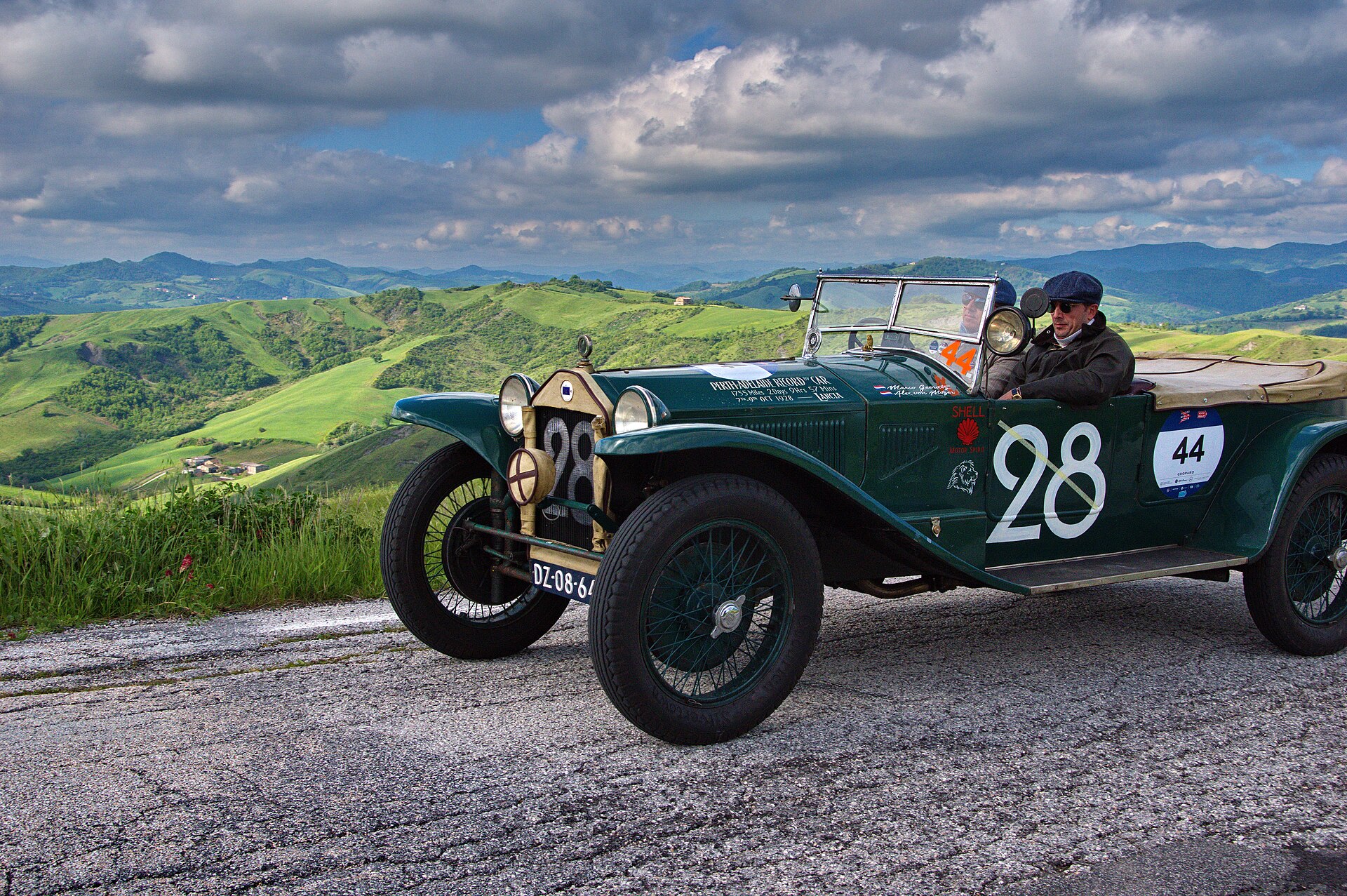
Lancia's history is often told as a procession of clever cars: Lambda, Aprilia, Aurelia, Fulvia, Stratos and Delta. That view captures the products but misses the industrial network that made them possible. At the end of the nineteenth century Turin brought together metalworking, coachbuilding, capital, technical education and ambitious mechanics. The Ceirano brothers and their associates stood at the centre of that network, and the teenage Vincenzo Lancia learned there before either Fiat or his own company had taken mature form.
This practical apprenticeship helps explain why Lancia's best work joined experimentation to use. Vincenzo learned construction, repair, testing and the consequences of a design when a customer had to live with it. The marque's later innovations were daring, but generally aimed at making a car lighter, safer, more compact or more usable.
Ceirano, Welleyes and the origins of Fiat
Giovanni Battista Ceirano established Ceirano & C. in 1898 with engineer Aristide Faccioli as technical director. Faccioli designed the small Welleyes car, rated at 3.5 horsepower, which was presented in Turin in April 1899. Treccani's history of the Italian motor industry records that the complete Ceirano operation—its patents, activity and car—was then acquired when Fiat was organised. Fiat's founding act was signed on 11 July 1899, and its first car grew directly from that acquired design and expertise.
Vincenzo Lancia had entered Ceirano's workshop in 1898. Treccani notes that his nominal position was an office job suited to his family's status, but his real education ranged through drawing, construction and repair. Faccioli taught him the fundamentals of automobile construction, while unreliable early cars taught him something equally valuable: design decisions become service problems for owners.
In 1900 Lancia moved with the Ceirano enterprise into Fiat. Still not twenty, he became a test driver whose feedback could shape developing models, then joined the racing team. He competed for Fiat for roughly eight years and earned a reputation for speed. Claudio Fogolin, another Fiat test driver, became his future business partner. Lancia's company was therefore not a rejection of Fiat; it was founded by two people formed inside Fiat's rapidly developing technical and organisational culture.
A company of their own, founded in 1906
Vincenzo Lancia and Claudio Fogolin formed Lancia & C. in Turin on 29 November 1906, each taking an equal share of the initial capital. The timing was difficult. An economic contraction was approaching, and a factory fire in February 1907 destroyed drawings, patterns and work already under way. The company survived both setbacks and introduced its first car, commonly known as the 12 HP, in 1908. Lancia's own anniversary releases give the founding date as 27 November; 29 November is the date on which Treccani records the partnership being constituted.
The early cars established a recognisable philosophy. They sought low weight without fragility, useful performance without harshness and careful construction without making the machine needlessly theatrical. Lancia also worked with specialist coachbuilders, reflecting Turin's wider ecosystem rather than attempting to control every part of a car's form. Exports to Britain and the United States began early.
Model names initially referred to fiscal horsepower. In 1919 the company began applying letters from the Greek alphabet retrospectively and to new models, giving early cars names such as Alpha, Beta and Gamma and preparing the sequence that would make Lambda one of the most important names in its history.
Lambda: invention serving the whole car
Unveiled at the London and Paris shows in 1922 and produced from 1923, the Lambda changed Lancia's standing from respected specialist to internationally important innovator. Its narrow-angle V4 was compact. Independent front suspension improved wheel control on the rough roads of the period. Most consequentially, its load-bearing body structure integrated functions normally divided between a separate chassis and body.
Those ideas worked together. Lower mass aided performance and economy; the structure contributed stiffness; independent front suspension improved security and comfort. The Lambda was not merely a laboratory demonstration: Treccani records approximately 13,000 built through 1931, far exceeding the production of Lancia's earlier Kappa. Commercial success gave the company a durable financial and technical base.
The Augusta and streamlined Aprilia continued the habit of treating packaging, aerodynamics and structure as related questions. Vincenzo Lancia died in 1937, shortly before the Aprilia entered production, but the company continued to work within the engineering culture he had established.
Aurelia and the postwar grand tourer
In 1950 Lancia introduced the Aurelia. Its compact production V6 is the headline innovation, but the car's significance is broader: engine, transmission layout, suspension and restrained body design combined to create a fast road car intended for long distances. The B20 coupé helped define the modern idea of the gran turismo, while the B24 Spider became one of the clearest expressions of Lancia's postwar elegance.
Competition success encouraged Gianni Lancia, the founder's son, to establish a dedicated racing organisation. That ambition produced important sports-car results and the technically advanced D50 Formula One car, but it also placed pressure on a company whose products were costly to engineer and build. Control changed, and in 1969 Lancia joined the Fiat group.
The change did not immediately erase the marque's character. Flavia had already brought front-wheel drive to an Italian production car; Fulvia combined that layout with competition ability and distinctive proportions. Later cars ranged from the mid-engined Beta Montecarlo to the Thema executive saloon. “Lancia engineering” was never one fixed mechanical recipe.
Stratos, 037 and Delta: several ways to win
Rallying gave Lancia its most visible later identity. The Stratos was conceived around competition rather than adapted from a family saloon. The rear-wheel-drive 037 pursued lightness and specialist construction in the Group B era. The Delta family then used turbocharging and four-wheel drive to dominate a different regulatory and technical landscape.
The World Rally Championship was first run in 1973, and the WRC's own list of champion cars names a Lancia in ten seasons: 1974, 1975 and 1976 with the Stratos, 1983 with the Rally 037, and six in succession from 1987 to 1992 with the Delta. Lancia's releases have used both ten and 11. The higher figure also counts the Fulvia's 1972 International Championship for Manufacturers, won the season before the WRC began, and the 2025 anniversary release that uses it cites 15 World Rally Championship titles elsewhere without a breakdown. That is why the category matters: manufacturers' championships should not be added casually to drivers' titles, predecessor series, individual rally victories or endurance results. The achievement is remarkable without inflating unlike records into a single number.
These rally cars also show why a simple story of continuous progress is misleading. Stratos, 037 and Delta succeeded with different architectures, rules and relationships to road production. The continuity lay in an organisation willing to choose a technical answer for the problem at hand.
Lancia at 120: Ypsilon, Gamma and WRC2
Lancia reaches its 120th anniversary in 2026 as one of the Stellantis brands. A new-generation Ypsilon, unveiled on 14 February 2024, was described then as the first of three models in the brand's plan; it is now sold in electric and hybrid forms. The same plan took Lancia back into other European markets from 2024.
The second model revives the Gamma name, which Lancia had already used for an early car in its retrospective Greek-letter sequence and again in the 1970s. The new Gamma is a 4.67-metre fastback crossover on Stellantis's STLA Medium platform, designed at Lancia's Turin design centre and built at the Melfi plant. Lancia released the first images on 26 May 2026 and presented the car at Italy's Ministry of Enterprises and Made in Italy in Rome on 16 September 2026. It is to be sold with hybrid and fully electric powertrains, topped by a 375 HP all-wheel-drive version.
Rallying has returned at world level too. Lancia Corse HF entered the Ypsilon Rally2 HF Integrale, developed with Stellantis Motorsport, in WRC2 from the Rallye Monte-Carlo in January 2026. At Rally del Paraguay in late August the team secured the 2026 WRC2 Teams' Championship with three rounds of the season left, a result also reported by ACI Sport. The category point made above applies here as well: this is a teams' title in WRC2, the class for Rally2 cars that runs alongside the top category, and it does not add to the ten manufacturers' championships.
What connects the eras
Lancia's history contains changes of ownership, uneven commercial results and long periods when its range did not resemble the heroic cars celebrated by collectors. A responsible history should not use the Lambda and Stratos to imply that every later decision followed the founder's method. Nor should difficult decades obscure what the company contributed.
The useful thread begins in Ceirano's workshop: understand the whole car, learn from testing and service, and make innovation answer a practical need. It leads through the Lambda's integrated structure, the Aurelia's compact V6 and long-distance ability, the Fulvia's front-drive precision and several radically different rally programmes. Lancia mattered because it repeatedly reconsidered how a car should be built—not because it applied one formula forever.
Sources
- Franco Amatori, “Vincenzo Lancia,” Dizionario Biografico degli Italiani, Treccani — Ceirano apprenticeship, Fiat career, company formation and Lambda history. Accessed 2026-08-14.
- Treccani, “Nascita e sviluppo dell'industria automobilistica” — Ceirano & C., Welleyes, Fiat's formation and Turin's early motor industry. Accessed 2026-08-14.
- Lancia, “119 years of style and innovation” — official model, ownership and competition chronology, including the 27 November founding date and the 11- and 15-title figures discussed above. Accessed 2026-08-14; rechecked 2026-09-24.
- WRC, “World Rally Cars (Champions)” — champion cars by season from 1973. Accessed 2026-09-24.
- Lancia, “Lancia synonymous with rally in the world” — the brand's own statement of ten World Rally Championship manufacturers' titles, and its 2024 return to Belgium and Luxembourg. Accessed 2026-09-24.
- Stellantis Heritage, “Lancia Fulvia Coupé 1.6 HF” — the Fulvia's 1972 International Championship for Manufacturers. Accessed 2026-09-24.
- Lancia, “40 years ago, Lancia won its fifth World Constructors' Championship with the legendary Rally 037” — counts 1983 as Lancia's fifth constructors' title, which includes 1972. Accessed 2026-09-24.
- Lancia, “New Lancia Ypsilon Unveiled Today” — the 14 February 2024 unveiling, the three-model plan and the return to other European markets. Accessed 2026-09-24.
- Lancia, “New Lancia Gamma: Lancia's new project comes to life in Italy, in Melfi” — first images, length, platform, powertrains and Melfi production. Accessed 2026-09-24.
- Lancia, “New Lancia Gamma presented at MIMIT” — the Rome presentation and Turin design work. Accessed 2026-09-24.
- WRC, “Lancia shows early promise on WRC return” — the WRC2 debut at the 2026 Rallye Monte-Carlo. Accessed 2026-09-24.
- Lancia, “Lancia Corse HF are WRC2 Teams' World Champions” and ACI Sport, “Lancia conquista il titolo Team WRC2 2026” — the 2026 WRC2 Teams' Championship. Accessed 2026-09-24.
Treccani was used for independent biographical and industrial context; Lancia's heritage material was used as a primary source for the marque's own chronology. Championship counts follow the WRC's own list, and the 2024–26 models and rally programme are taken from Lancia's releases, with the WRC2 title checked against ACI Sport. Promotional superlatives were omitted or qualified. No archived italiancar.net prose was reused.